Just a Spark of Kindness Lights The Way

Sometimes, it takes a kid to teach us the most important lessons

For summer camp this year, our small Scout troop (505, Earl Twp., Pa.) spent a few days at a Scout reservation in Maryland. The kids got to work on merit badges, explore career options, strike up new friendships, and learn leadership and life skills.

And while our troop makes lasting memories at every summer camp, I think this particular trip is going to stick with us for a long time.

The Scout Law

One of the things we work to instill in our Scouts is kindness to others. In fact, it’s right there in the Scout Law:

A Scout is:

  • Trustworthy
  • Loyal
  • Helpful
  • Friendly
  • Courteous
  • Kind
  • Obedient
  • Cheerful
  • Thrifty
  • Brave
  • Clean
  • Reverent

But let’s face facts: Anyone who remembers their school days knows kids can be savagely mean. And if you look, sound, or act differently than your peers? It’s like wearing a sign that says, “kick me!”

Forging bonds

This year, one of our Scouts made friends with a younger boy from another troop. The boy’s troop had skipped summer camp, so it was just him and his dad—a lonely proposition for a tween. Each evening after dinner, he’d seek out his new friend, and the pair of them would rush off to join other Scouts for a few games of Gaga Ball (and a temporary break from the adults).

On the last night of camp, our Scout was busy trying to finish a merit badge project, so his friend went to the ball pit without him.

But before long, the boy came running into our camp, tears streaming down his face, yelling hoarsely for his pal.

“What’s wrong?” one of our leaders asked.

“The other kids were picking on me,” he said between sobs. “They called me ‘fatty.’ They called me ‘biggie.’ They called me “fat ass.” And then one of the kids hit me, and he tried to drag me out of the Gaga pit.”

This is decidedly not Scout behavior, and we were pretty shocked. Just then, our Scout returned from his merit badge session, breaking into a run when he saw his friend’s face. He quickly comforted the boy, putting his arm around his shoulder and asking if he’d been hurt.

After he’d heard his friend’s story, our Scout’s first instinct was to race off and confront the bullies. But cooler adult heads prevailed. The incident was reported, and the offending kids were summoned to the Scout office. We thought that would be the end of it.

But then something truly wonderful happened.

Kindness Summed Up … In a Brand?

Later that night, the camp held a farewell social that included S’mores and the branding of camp souvenirs. Scouts gathered around a fireplace while a special iron with the camp’s initials was heated in the flames, then pressed, sizzling, onto hats, leather belts, and other camp gear.

Seeing that each member of our troop had a mug to brand, the boy asked if he could get one, too. But the camp store had run out of them. His face fell, and his lip quivered, just for a second.  “Oh, OK,” he said.

But our Scout saw his friend’s dejected face. And he quickly piped up, “Here, you can have my mug. I don’t need it.”

Soon, the boy was beaming as he watched the hot brand press into his souvenir with a hiss.

When the social ended, knowing his friend was still shaken by the earlier encounter, our Scout asked if he could invite the boy to our own closing campfire, “to make him feel better.”

We said yes, of course.

And for the next hour-and-a-half, those kids laughed, joked, sang goofy songs, talked about the Minecraft movie, and debated the finer points of Pokémon.

At one point, without any adult prompting, they discussed what it means to be kind, friendly, courteous, and trustworthy. Before long, that boy’s eyes, which just a few hours earlier had been filled with tears, were shining.

That boy could have gone home with bitter feelings and awful memories of a camp where he was excluded, bullied, and teased. Instead, he left with great stories to tell, a one-of-a-kind souvenir, a bunch of new friends, and the knowledge that even when things get ugly, there are kind, caring people who are willing to lend a hand.

When the adult leaders talked later that night, we thought we couldn’t have asked for a better end to this story.

But there was still a little camp magic in store for everyone.

The Plot Twist

The next morning, unbeknownst to the adults, the boy who’d been attacked went with our Scout to confront his bullies before they cleared out of camp.

But he didn’t yell at them.

He didn’t mock them for getting in trouble.

What he did next is a lesson in maturity and compassion for all of us:

He forgave them.

And that started a catalyst. The offending boys admitted they were wrong. They even said they weren’t sure why they’d been so mean in the first place. And then they all “dapped each other up” (Gen A for “shook hands”).

In a society where bullying by our most powerful leaders is not just tolerated, but in some circles, celebrated, stories like this need to celebrated. They give us hope: hope that our society is better than the bullies; hope that some bullies may yet see the light; hope that good will win the day; and hope that the future is brighter than it often seems.

Be The Light

There’s one final detail to this story: The Scout from our troop who helped his friend?

He’s my son. And my eyes get damp every time I think about what he did (must be the pollen count … ).

My son has been bullied since preschool because of his neurodivergence. While he’s extremely intelligent and capable, he views the world through a unique lens—and it’s not one many other kids his age can see through. ADHD makes extended concentration an often-impossible chore.

Navigating social situations is, to say the least, a challenge. Hyper-fixations are the norm.

And so, unfortunately, is getting picked on because he’s different.

But instead of turning bitter and lashing out, my son goes out of his way to lift others up. He always tries to be a friend; to stand up for the downtrodden. He looks for the good in people first, rather than focusing on appearances or stereotypes.

Does he make mistakes and test the waters?

Of course; he’s a teen. Some days I feel like I’m going to pull out all of my rapidly graying hair before he graduates high school. I’m often reminded of my own childhood, and the many gray hairs I gave to his grandparents.

But there are just as many times that he humbles me, or fills me with pride—and this year’s Scout camp was one of them. He and his friend showed all of us—adults and kids alike—that just a spark of kindness and compassion can push back the darkness and light the way forward.

Nature vs. Nintendo, Treehouses, and a New Project

66844506_10157387724592387_6259759523607609344_n
It’s not as high off the ground as it looks!

I’m a firm believer in outdoor time over screen time. I think many of our kids today suffer from NDD – Nature Deficit Disorder (a term coined by author Richard Louv).

Those who know me well also know that I’m an avid environmentalist — and that I fully embrace the Reduce, Reuse and Recycle principle.

With those ideas in mind, a few years ago I started building a treehouse with my sons — and we’ve been adding to it ever since. It’s not exactly pretty. It probably doesn’t meet the Consumer Product Safety Commission’s guidelines for playground equipment. But two out of two kids agree – it’s pretty flippin’ awesome.

So far, it has two tire swings. Two Hot Wheels tracks. A zip line. A slide. A solar light. A pulley hoist to get said Hot Wheels (and books, of course) into the treehouse.

And EVERYTHING — from the wood, to the slide, to the nails — was free. Some things came from the farm I grew up on when we sold it last year. Some came from the side of the road. Some of it was rescued from the trash.

But the best part? I get to work with my kids on this project. They’ve learned how to use a level, a measuring tape, a hammer and nails. They’re learning that there’s a better solution than tossing everything in the trash, then running out to buy shiny new things. And we get to spend quality time outdoors.

I realize not everyone can pull off a project like this. My boys and I are fortunate to live in the woods, and working from home gives me some flexibility (I have to meet client deadlines, so there are times I’m still working at 2 a.m.).

But all of us can make time to walk with our kids in the park, or play in the yard, or build a birdhouse or bird feeder from recycled materials. And that’s all it takes to introduce the concept that there’s life beyond a screen, that nature is our ally, and that everyone can help the planet in some small way.

It’s not always easy. As I write this, I’m also arguing with my oldest because he’s not respecting today’s screen time limits (spoiler alert: I’ll win, because there’s a power button). But it’s absolutely worth it.

I’m such a firm believer in helping our planet that I’ve made it the theme of a series of middle-grade novels I’m working on. They revolve around a young girl who loves even those animals that aren’t (to most people) exactly cute and cuddly— like bats and snakes. She’s passionate about helping them, and about helping the grownups around her understand that every animal has its place in the ecosystem.

I’m hopeful that I’ll be rolling out the first in the series sometime next year — but that all depends on our next treehouse addition. These construction projects take time, you know!

66781851_10157387724712387_5065358895598272512_n
Washing the gunk off our found slide (though they should have done that before taking test slides — hope I can get the stains out of those clothes!).

Fanfare for an uncommon man

The night my Pop died, I knew it would be his last. I’d been working late, writing something for a client, when it suddenly hit me. I clocked out and started writing his eulogy instead. For the next several hours I wrote, revised, and rewrote, then went to bed, exhausted. I woke at 4:50 a.m. to a phone call confirming what I already knew.

I wasn’t “taken over,” a description I’ve heard others use for similar experiences. But I will say that the theme and the life events I described came to me easily — I’ll call it divine inspiration, or some sort of guidance. This fact became more clear to me when a cousin told me she had the same feeling while she penned a tribute to him a few days after his death — and when she realized that what she wrote mirrored much of what I went on to say in my eulogy.

What follows is what I’ll call Fanfare for an Uncommon Man — with apologies to composer Aaron Copeland (and Emerson, Lake and Palmer). I’ve changed a few of the words — I’m sure you can figure out which ones they are — because the language my Pop would have used isn’t exactly fit for the inside of a church.

Fanfare for an Uncommon Man

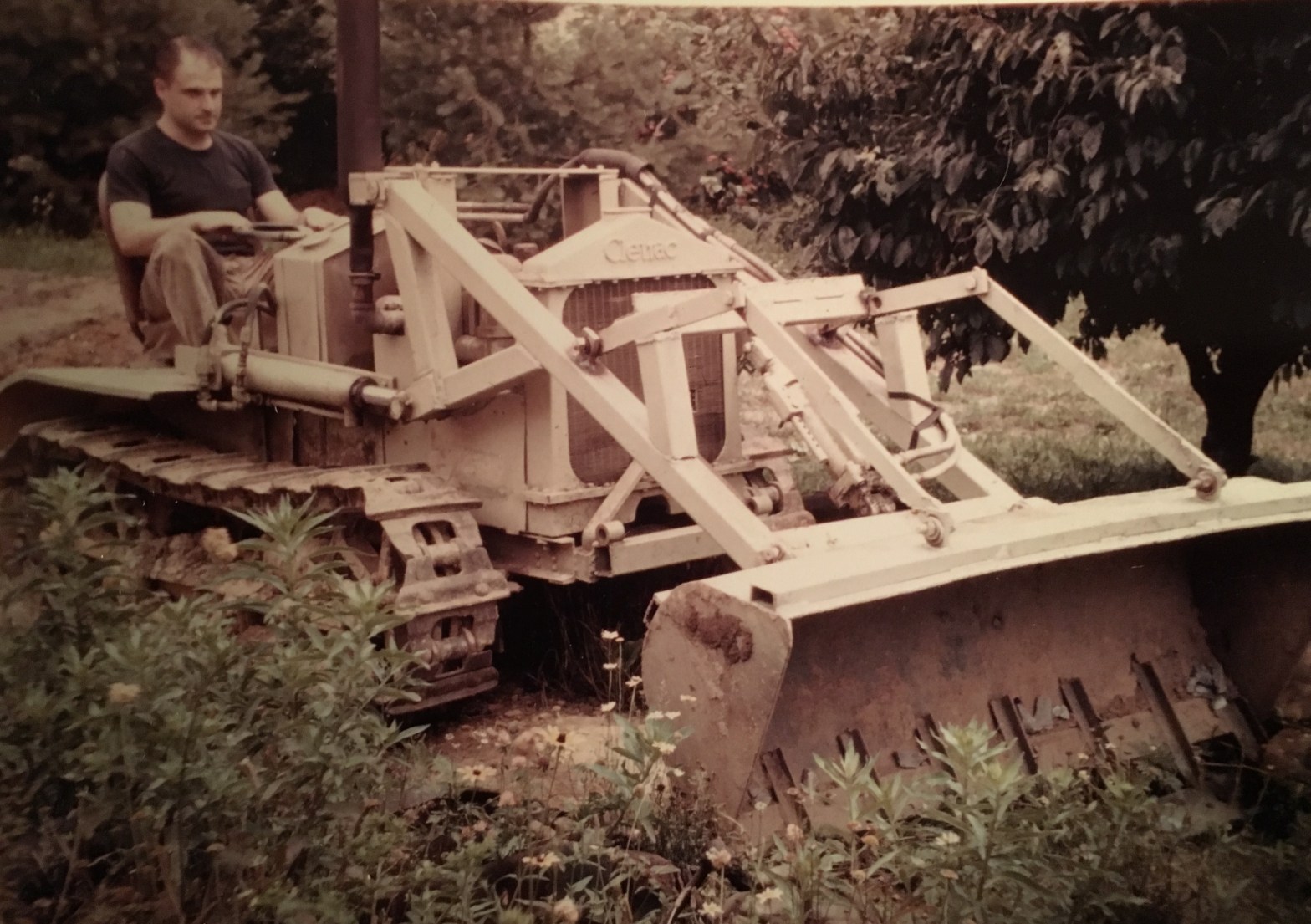
My father was a hard worker. He was also a mechanical genius.

Some people know a little about everything — they’re a “Jack of all trades, master of none.”

That was not my father.

My father was a master of all trades.

Carpenter. Electrician. Gas and diesel mechanic. Surveyor. Plumber. Mason. Fabricator. Welder. Farmer. Roofer. Machinist. Engineer. Architect …

I could go on, but I think you get the idea.

Over the course of his life, the man built more things, from the ground up, then it’s possible to catalog. Bulldozers. Tractors. Trucks. Cars. Houses. Barns. Farm equipment — he once built a gravity-fed seeder, for our corn and oats, out of salvaged parts that included an old bucksaw blade; a water tank, a driveshaft to transfer power from the PTO, and a gear unit that he modified to run the saw blade. Onto the blade, he’d welded metal stock to catch and carry the seed — fed through an adjustable delivery system. He completed it with a three-point hitch setup to attach to our Farmall tractors.

vintage bucksaw — my father used a similar blade to make a seeder for our crops. It wasn't exactly safe, but it worked!
My Pop used a blade just like this one when he made a seeder for our crops. It wasn’t exactly safe — especially for the person (me) who had to stand next to it, on a moving tractor, and adjust the rate the seed fell — but it worked!

And that was one of his simple projects (although not one of his safest — have you ever stood next to a spinning bucksaw blade to adjust a seed feeder?)

He custom-designed and helped build entire machines for one of the knitwear companies he worked at, saving them the hundreds of thousands of dollars it would have cost to purchase those machines new.

He built two of the houses that he and my mother have lived in over their 57 years of marriage. And when I say built, I mean he did everything but pour the foundation (he dug them out, though).

His nephew, my cousin Rick, once said, “When your dad sees a toaster, he doesn’t see what everyone else sees. He sees the wiring schematic, the solenoid, the thermostat, the switch, the heating element, the lever — everything that makes it work.”

It’s one of the best descriptions I’ve ever heard of how my father saw things.

And he didn’t like sitting still, especially as a younger man. While other people were watching Sunday football or going to movies or taking vacations — all pretty pointless pursuits in my father’s eyes — he was working. He’d come home from his full-time job, eat the dinner my mother prepared, and go straight out into the field or the garage or the barn and stay there until long after the sun went down. All of our farm equipment had been modified with multiple lights — you could often find us plowing a field, planting seed, or harvesting crops well after everyone else was in bed.

That’s not to say he didn’t have fun once in a while. As a younger man, he was a bit of a speed demon. In England, where he met my mother, he rode a BSA Motorcycle and drove a jalopy he’d built on his Air Force base. Back in the states, he built and raced go-karts. He was a car enthusiast who rebuilt a 1928 Model A; owned his share of ‘50s Cadillacs, and once owned an MG purpose-built for racing.

He liked snowmobiling — our first was an antique AMC that he resurrected from a neighbor’s barn. In fact, he liked snowmobiling so much, he bought himself a vacation home in Upstate New York, land of the lake effect snow.

Of course, when I say he “bought a vacation home,” what I mean is, he bought land, cleared it, put in a well, a septic system, an electrical hookup, laid a pad, then bought a camper and “stored” it there permanently. (You see, my dad was also frugal – why the hell would you pay the taxes for a house when storing a camper is cheaper?)

As you might know, he was also a stubborn man, and he was never one to admit when he was wrong — or beaten. There was no arguing with my father — once he’d made his mind up, he did not change it. Sometimes I think that’s how he managed to get anything to grow at all during those lean years when the rains were few and the sun baked the rocks that served as soil on our stretch of the Blue Mountain.

That stubbornness was how he and my mother managed to face down a deep-pocketed developer who threatened to destroy not just their way of life, but that of anyone in Eldred Township and beyond. Incensed, he and my mother formed the Blue Mountain Preservation Association when a would-be race track owner made plans to deforest and degrade almost 500 acres of fields, woods and wetlands that border their home. After a 12-year fight, they won — and those peaceful acres are now permanently protected State Game Lands – free for anyone to enjoy, no motors required — or allowed.

That stubbornness is also how he faced his last months of life — at first refusing to even acknowledge the possibility that he was very ill, and then fighting like hell once he learned he might have a chance, no matter how slim.

He was a dedicated husband, father and Catholic, he lived a full life, and we will all miss him.

I’d like to thank you for coming here to celebrate the life of my father, Francis Z. O’Donnell, and for taking the time to mark his passing with us. And just so you know, somewhere right now he’s watching all of this and saying, “Hmph. Imagine that. They’re sitting around wasting time bullshittin’ about me when they should be gettin’ work done.”


On life, presence, the speed of childhood and the perils of rushing

Last night I had some rare one-on-one time with my oldest, who will be 9 in what seems like a heartbeat. 

As I tucked him in, he asked me to sing him a song – something he hasn’t asked for in a while. I was feeling frustrated, tired, irritable, and just wanted him to go to sleep, but then I took a moment to realize the importance of what he was asking. I don’t always do that, in many aspects of my day-to-day routine. I find myself too caught up in the rush of work, parenting, and navigating life, and I don’t take time to listen. 

So I asked him what he wanted. We settled on “Hey Jude,” and after that, he asked for the song I used to sing to him every night as a baby: “Moonshadow.” So I sang that, too, and tried not to let the lump in my throat get in the way. As I did, he relaxed, sighed, snuggled up to me, put a hand on me, and closed his eyes. When it was over, he opened his eyes again and asked me, “How old are you again, Dad?” “48,” I told him. He thought about that for a moment, and a troubled look passed over his face. “I don’t want you to get older, Daddy,” he said. “And I hope your voice never changes because I really like the way your voice sounds when you sing to me, and I don’t want that to change if you get older.”  
It was a bittersweet moment for me. It was a reminder that life passes quickly, and that we all get older, and that our children grow in an instant, and it left me with tears in my eyes. It was a reminder that if I don’t slow down and take notice of each moment, instead of racing from one to the next, I’m going to miss the most important things in my children’s – and my own – life. 

“Life is a journey, not a destination.” My son’s words last night illustrated that perfectly, and were a reminder that I need to be present for the journey instead of focusing on, and rushing toward, the destination. 

be present in the moment, and focus on the journey, not the destination
My oldest son at a time that simultaneously seems like an age ago, and also the space of a heartbeat.

Reflections on an interview with Maynard Ferguson

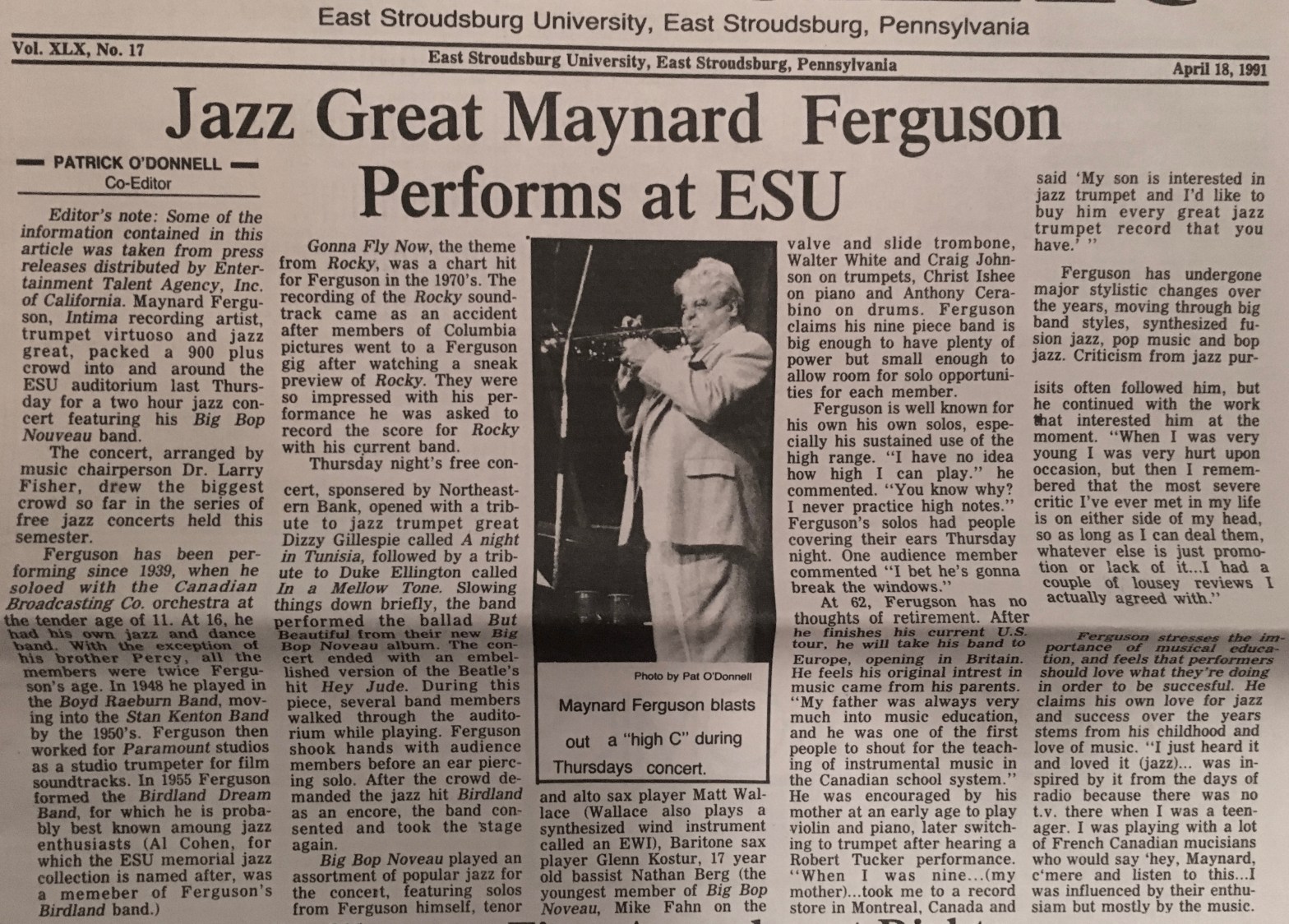
I was digging through my “archives” [i.e., a bunch of musty old newspapers in a cardboard box in my office) in search of something when I stumbled on this story from college.

Unfortunately, it focused more on Maynard Ferguson’s backstory and the concert than the interview I got to do with him beforehand – and that’s the part that left the biggest impression on me.

I was a nerdy, nervous college kid way who felt way out of my depth in the presence of a man who simply exuded greatness. But Ferguson put me at ease in minutes in the faded, decades-outdated space that passed for ESU’s backstage dressing room. He was humble, polite, funny, and very conversational.


He asked me if I played anything, and when I told him about my high school jazz band days on valve trombone he instantly treated me like we’d been friends for years; peers, even (hah!). We talked about that unmistakable seven-note bass line in “Birdland,” emptying spit valves, the buzzy feeling your lips get after playing for a long time, and the often-overlooked value of music education in schools.


As I reread the story tonight, I got goosebumps remembering that I bonded over brass with such a legend, and didn’t even realize the significance of it at the time. I do know that for quite awhile afterward, I dreamt of playing again, missing it with a deep ache.


One of the other things we talked about was his practice of meditation (he was just finishing up when I arrived to do the interview, and I had to wait outside. I think he even had some candles lit on the vanity table when I walked in). He told me how he’d learned to use yoga, long before it was “cool,” to help his breathing and how it helped him hit those high notes he was so well known for. Later, in concert, he literally blew us all away and made our ears ring for hours afterward. It was an experience I’ll never forget.


So, in tribute to Maynard, click on the link below for a hair-raising version of “Birdland.” If you want the true Ferguson experience, crank it up to 11 and put your ear next to the speaker when he solos (Note: this will cause deafness. If there truly are trumpets in heaven, I’m sure he’s leading the seven-angel band — the man could blow down walls with a single note.)  


#maynardferguson #jazz #birdland